Why Human Judgment Matters More Than Ever
As businesses race to integrate artificial intelligence into every product and workflow, a growing number of builders are arguing for a more measured approach: use AI to accelerate creation, but avoid becoming dependent on it.
The Wrong Question
For the past few years, conversations about artificial intelligence have been dominated by fear.
Will AI replace programmers?
Will AI eliminate creative jobs?
Will entire industries disappear?
These questions have filled boardrooms, social media feeds, and technology conferences around the world.
Yet beneath the anxiety lies a more important development.
Artificial intelligence is not simply changing how work gets done. It is changing what humans are expected to contribute.
Historically, value came from execution.
A programmer who could write software faster than others had an advantage. A designer who could produce better designs had an advantage. A writer who could transform ideas into compelling stories had an advantage.
Today, AI is rapidly reducing the scarcity of those abilities.
Modern AI systems can write code, generate articles, create videos, produce designs, analyze data, and summarize research in minutes. Tasks that once required days of effort can now be completed in a single afternoon.
As a result, knowledge itself is becoming increasingly commoditized.
This does not mean human expertise is becoming irrelevant.
It means its role is changing.
The New Bottleneck
The bottleneck is no longer execution.
The bottleneck is judgment.
Knowing what to build is becoming more valuable than knowing how to build it.
Understanding which problems deserve attention matters more than the ability to perform every step manually.
In many industries, the competitive advantage is shifting from production to decision making.
The future worker may resemble a conductor leading an orchestra rather than a specialist performing every task personally.
AI tools, software platforms, automation systems, and human teams are increasingly becoming instruments that need coordination.
The individual who understands how to combine them effectively will create disproportionate value.
Everyone is becoming an orchestrator.
AI Doesn't Replace Work. It Changes It.
This shift is already visible everywhere.
Developers use AI to accelerate software creation.
Writers use AI to organize ideas and draft content.
Designers use AI to generate concepts and iterate rapidly.
Researchers use AI to process information at a scale that would have been impossible only a few years ago.
The common theme is simple:
Humans are spending less time translating ideas into outputs and more time deciding which outputs are worth creating.
That distinction has enormous implications for businesses.
The Mistake Many Managers Are Making
Many organizations view AI primarily through the lens of cost reduction.
When a team can accomplish a day's work in a fraction of the time, the immediate reaction is often:
Can we reduce headcount?
That may be the wrong question.
A customer complaint that once sat unresolved for several days could potentially be addressed within minutes.
Product teams can run more experiments.
Operations teams can eliminate bottlenecks.
Support teams can focus on more complex issues that require empathy and judgment rather than repetitive administrative work.
The opportunity is not necessarily to remove people.
The opportunity is to remove friction.
History has repeatedly shown that productivity gains create new possibilities rather than simply reducing the need for human involvement.
The organizations that win will not be the ones that eliminate the most employees.
They will be the ones that empower employees to solve bigger problems.
The Cost Nobody Wants to Talk About
Most conversations about AI focus on capability.
Very few focus on cost.
A consumer subscription may cost twenty dollars per month, but operating AI systems at scale is a very different story.
Behind every AI-generated response sits an enormous infrastructure of:
- GPUs
- Data centers
- Storage systems
- Networking equipment
- Cooling infrastructure
These systems consume:
- Electricity
- Water
- Hardware resources
- Ongoing operational budgets
Many companies begin with a simple AI feature and later discover monthly infrastructure bills reaching hundreds or even thousands of dollars.
The reality is that AI remains expensive.
And the more successful a product becomes, the more expensive that dependency can be.
Not Everything Needs AI
The technology industry has a habit of treating every new tool as a universal solution.
During the rise of mobile apps, every company wanted an app.
During the blockchain boom, every problem seemed to require decentralization.
Today, many organizations are approaching AI with the same mindset.
Every feature becomes an AI feature.
Every workflow becomes an AI workflow.
Every decision becomes an AI decision.
But not everything requires artificial intelligence.
In many cases, AI is most valuable during the creation phase rather than the execution phase.
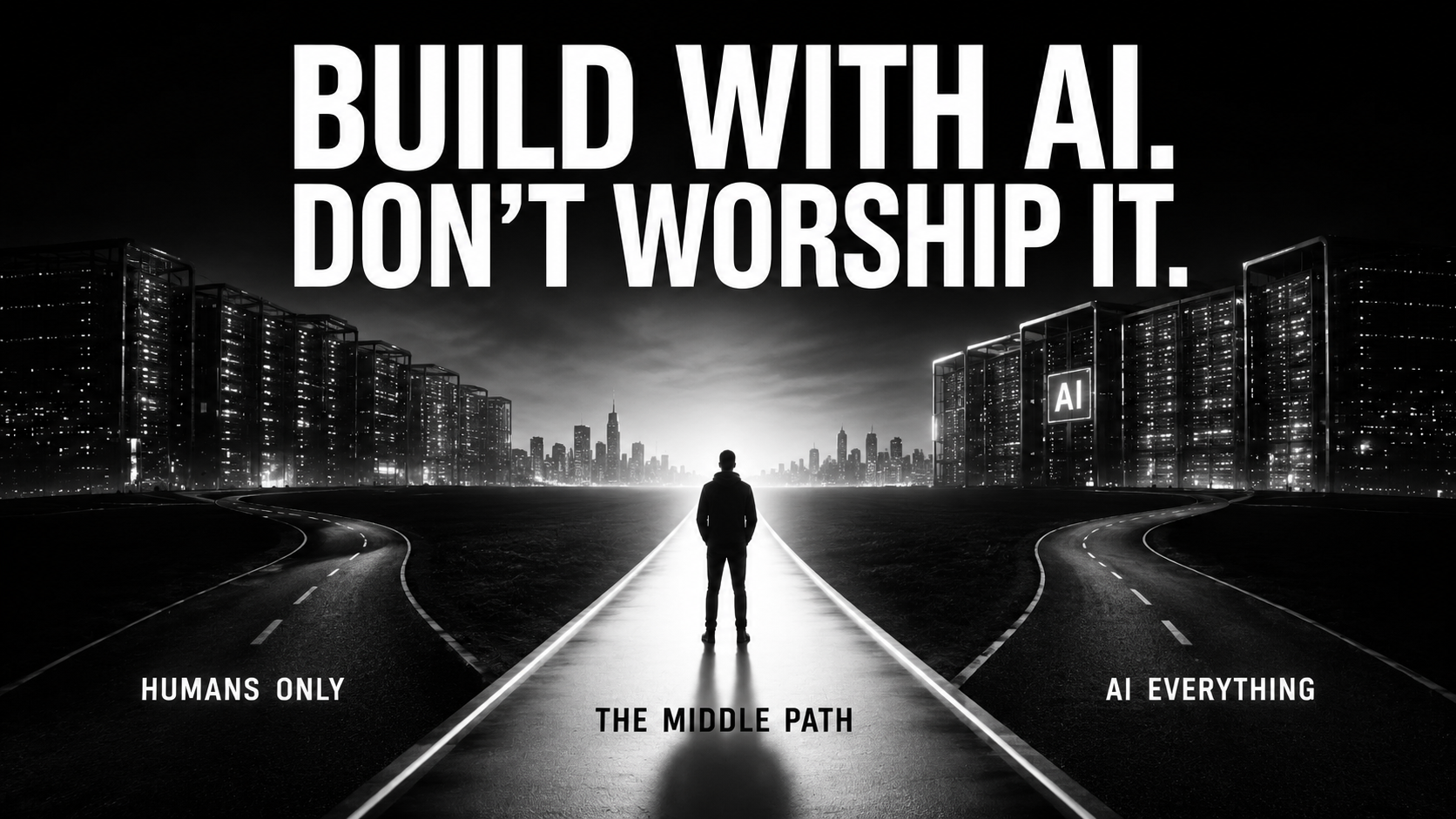
Build With AI. Don't Build Everything Into AI.
This distinction may define the next decade of technology.
AI is extraordinarily useful for:
- Generating ideas
- Writing code
- Creating designs
- Producing content
- Analyzing information
- Accelerating experimentation
It dramatically reduces the distance between imagination and execution.
A founder can sketch an idea in the morning and have a working prototype by the evening.
That is remarkable.
However, once a process has been designed and validated, it does not necessarily require AI at every step.
Traditional software, automation, and optimized workflows are often:
- Faster
- Cheaper
- More predictable
- Easier to scale
The goal should be simple:
Use AI to create better systems.
Don't turn every system into an AI problem.
The Mumbai to Delhi Analogy
Imagine driving through your backyard.
You wouldn't drive at 100 km/h.
That would be reckless.
Now imagine driving on an expressway from Mumbai to Delhi.
That's where speed becomes valuable.
AI works the same way.
There are situations where large AI models provide extraordinary value:
- Research
- Strategy
- Software development
- Creative exploration
- Complex analysis
There are other situations where simplicity, predictability, and human oversight matter far more.
The skill lies in understanding the difference.
Knowing when to use AI may become more important than knowing how to use AI.
Why Humans Must Remain in Control
This distinction becomes critical when decisions carry significant consequences.
A mistake made by a human is usually limited in scope.
A mistake made by an AI system can be replicated instantly across an entire organization.
In highly regulated industries, public services, financial systems, healthcare, and critical infrastructure, unchecked automation can create risks that extend far beyond individual users.
Human oversight remains essential.
Not because AI is incapable.
But because responsibility cannot be delegated to a machine.
As the old saying goes:
Speed without direction is just acceleration.
AI provides speed.
Humans provide direction.
The Real Competitive Advantage
Artificial intelligence can generate possibilities.
Humans must determine which possibilities are worth pursuing.
It can optimize processes.
Humans must decide whether those processes should exist.
It can increase speed.
Humans must decide where that speed should be applied.
For all the discussion about AI replacing human work, the deeper transformation may be the elevation of human judgment itself.
As execution becomes easier and cheaper, the value of wisdom, context, accountability, and decision making increases.
The future may not belong to the organizations with the most AI.
It may belong to the organizations that understand:
- Where AI belongs
- Where AI doesn't belong
- How to balance the two
Conclusion
The future is not humans versus AI.
The future is humans working alongside AI.
AI gives us leverage.
AI gives us speed.
AI removes friction between thought and creation.
But judgment remains human.
Responsibility remains human.
Direction remains human.
Faq
Is AI going to replace human workers?+
AI is more likely to change the nature of work than eliminate it entirely. As AI handles repetitive execution, human value increasingly shifts toward decision making, creativity, judgment, accountability, and oversight. The people who thrive will be those who learn how to work alongside AI rather than compete against it.
What does "Everyone becomes an orchestrator" mean?+
It means humans will increasingly coordinate AI tools, software systems, workflows, and teams instead of performing every task manually. The ability to direct multiple systems toward a goal becomes more valuable than performing individual tasks in isolation.
What is the difference between building with AI and building everything into AI?+
Building with AI means using AI to accelerate research, coding, design, content creation, and experimentation. Building everything into AI means making AI a dependency for every workflow and feature. The first approach often reduces costs and complexity, while the second can increase both.
Why shouldn't companies immediately reduce headcount after adopting AI?+
Productivity gains create opportunities to solve larger problems. Teams that complete work faster can focus on innovation, customer experience, operational improvements, and new products. Organizations that reinvest productivity gains often outperform those focused solely on cost reduction.
Why is AI expensive despite low monthly subscription costs?+
Consumer subscriptions only reveal a fraction of the cost. Large-scale AI systems require GPUs, data centers, networking infrastructure, electricity, cooling systems, storage, monitoring, and maintenance. As usage grows, these costs can increase significantly.
Does every product need AI?+
No. Many products and workflows can operate more efficiently using traditional software and automation. AI is most valuable when it removes uncertainty, accelerates decision making, or handles complex tasks that would otherwise require significant human effort.
What is the biggest mistake businesses make with AI?+
Treating AI as a universal solution. Not every workflow benefits from AI, and not every decision should be automated. Successful organizations focus on applying AI where it creates meaningful value rather than using it everywhere.
What does "The bottleneck is judgment" mean?+
AI has dramatically reduced the time required for execution. As a result, the limiting factor is increasingly human judgment: deciding what to build, which opportunities to pursue, what risks to accept, and which outcomes matter most.
Can AI improve customer experience?+
Yes. AI can help organizations respond faster, reduce wait times, automate repetitive tasks, analyze customer feedback, and improve support processes. However, human oversight remains important for handling nuanced situations and maintaining trust.
Why compare AI to driving on an expressway?+
The analogy highlights that speed is only useful when applied appropriately. Just as you would not drive at highway speeds in a backyard, you should not use the largest or most complex AI systems for every task. The skill lies in choosing the right level of intelligence for the situation.
Why is human oversight still important?+
AI can make mistakes and those mistakes can scale rapidly. In areas such as finance, healthcare, government services, and critical infrastructure, human review helps ensure accountability, compliance, safety, and ethical decision making.
What is the future relationship between humans and AI?+
The most likely future is collaboration rather than replacement. AI will provide speed, scale, and automation, while humans provide judgment, context, creativity, ethics, and strategic direction.
What skills will become more valuable in the AI era?+
Critical thinking, decision making, leadership, communication, systems thinking, problem solving, creativity, and the ability to coordinate people and technology effectively are likely to become increasingly valuable.
Should startups build AI-first products?+
Startups should focus on solving meaningful problems rather than chasing trends. AI can be a powerful tool, but it should serve the product's purpose. The best products often use AI where it creates clear value and avoid it where simpler solutions work better.
What is the core message of "The AI Middle Path"?+
Artificial intelligence is an extraordinary tool for accelerating creation and innovation. However, organizations should avoid blindly embedding AI into everything. The most sustainable approach is to use AI where it adds value while maintaining human judgment, responsibility, and control. ```